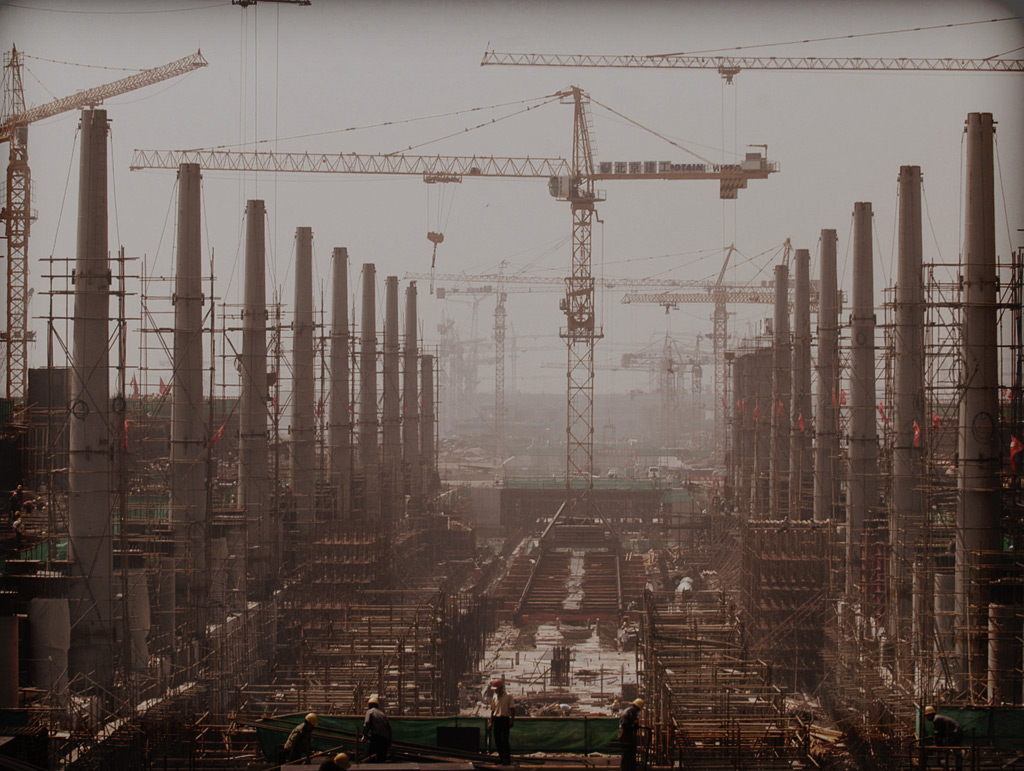









Ramping up its export juggernaut and taking full advantage of WTO entry, China’s economy in the first decade of the new millennium was “boom with no bust.” The information revolution fed more growth, as hundreds of millions of Chinese came online. But the Internet also became a forum for discontent, and the new leadership team of Hu Jintao and Wen Jiabao acknowledged growing environmental and social justice concerns with their call for a more harmonious society. Then, as the credit crisis in the US spread into a global economic crisis, China’s export-dependent growth appeared in jeopardy, and fears of a Chinese crash surfaced. But, as in 1998, China weathered the storm, and emerged in 2010 as the world’s largest exporter, largest foreign creditor, and fastest growing major economy, poised to soon surpass Japan and eventually eclipse the United States as the biggest economy on the planet.
Tan Jun, from Hunan province, is a 21 year old migrant worker who works at a manufacturing factory. Tan Jun has a junior high school education, but he never attended high school. Both of his parents are farmers in the countryside.
When I was small, there was only enough to eat. Work, eat and nothing more. From the time I could remember, things now are much better than they were. Before, everyone was just poor. We lived in a tile-roofed house. But the house was severely dilapidated and it was not even much of a house. Most houses in my hometown were just like that. Because of China’s economic development, things are now much better than what I was younger. I think if things keep developing this way I believe that we'll leave poverty behind. I think my dream at the time was to start a business and then make my home better.
However, once I came here things were not as simple as what I had imagined. Here things are pretty difficult. Now I feel like I can't stay any more, especially after learning more about the society. In some factories, you can't even get wages. Also in terms of social security... some factories buy social securities for their workers, but at most they'll only buy it for 100 workers, and they average it out. For example, you brought the social securities for 100 people, and one worker gets hurt, they'll kick one person out of the 100, and insure the one who got hurt. I feel like the bosses aren't very good to the workers. The work hours are very long. Our factory has fixed hours, from 8 a.m. to 8 p.m., 12 hours. But some factories... it's from 8 a.m. to 11 p.m. or 12 a.m. So it's really difficult here. The world out here isn't as simple as I thought.
(Interviewer) How did you imagine it to be?
What I thought it would be like is... I would simply find a job, and of course I wouldn't have much money at first, but I would first take care of the basics of life, and then I would slowly save and help my family. But here the commodity prices are high, in a month you don't have that much money left over to save. Sometimes you can't even maintain your own lifestyle. So I think it's very problematic.
Add New Comment
comments powered by Disqus