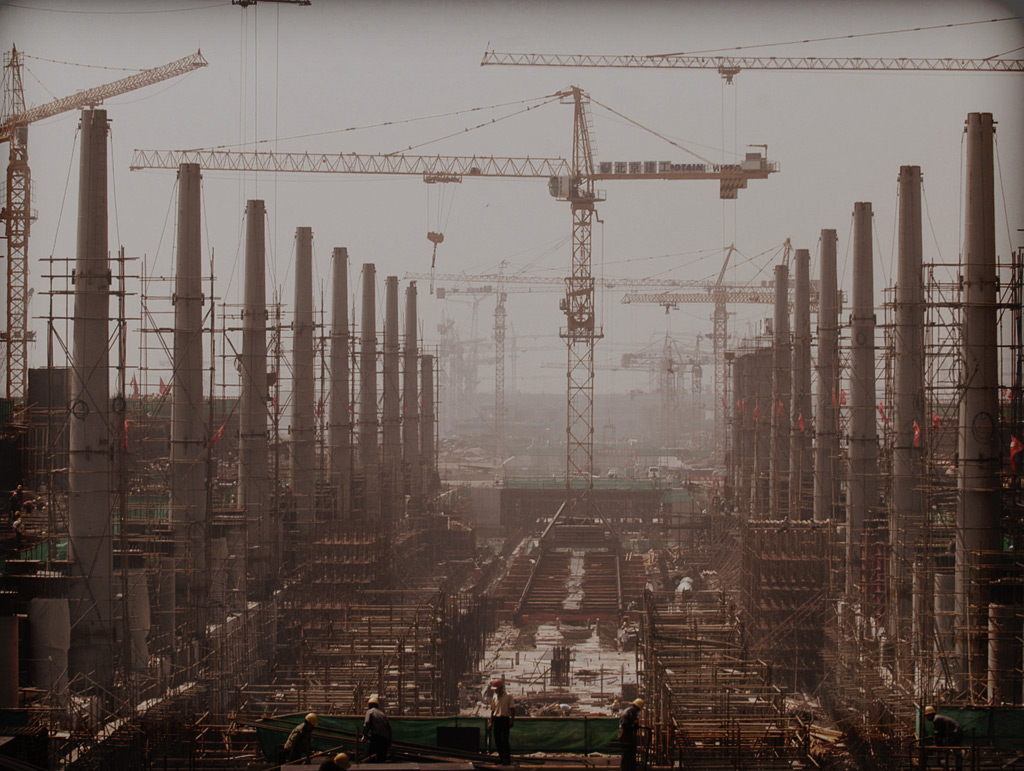









Ramping up its export juggernaut and taking full advantage of WTO entry, China’s economy in the first decade of the new millennium was “boom with no bust.” The information revolution fed more growth, as hundreds of millions of Chinese came online. But the Internet also became a forum for discontent, and the new leadership team of Hu Jintao and Wen Jiabao acknowledged growing environmental and social justice concerns with their call for a more harmonious society. Then, as the credit crisis in the US spread into a global economic crisis, China’s export-dependent growth appeared in jeopardy, and fears of a Chinese crash surfaced. But, as in 1998, China weathered the storm, and emerged in 2010 as the world’s largest exporter, largest foreign creditor, and fastest growing major economy, poised to soon surpass Japan and eventually eclipse the United States as the biggest economy on the planet.
Vice Director for Research, Party School of the Communist Party of China
Zhou Tianyong, born in 1958 in Min He County in Qinghai province, is the vice director of Research at the Party School of the Communist Party of China's Central Committee (CPCCC). He is a professor of Economics at the Beijing University of Technology and also an expert pricing consultant for the National Development and Reform Commission.
Zhou studied investment banking at Dongbei University of Finance, graduating in 1984. He remained at the university, beginning PhD studies in 1989, under the supervision of Professor Wang Xiangchun. Since completing his doctorate in 1992, Zhou has been working and conducting research at the Party School of the CPCCC since 1994. He specializes in and has published numerous articles on Socialist economic theories, macroeconomics, economic development and growth, labor economics, financial risk, and urban and rural economies.
Within the previous planned economy and centralized regime, the control was very strict. There was corruption for getting a business license and inside deals by those self-employed business, private enterprises and collective enterprises occurred. Now I think under the current market economy, less government intervention means less corruption and more transparency. Complicated bureaucratic and prescreening procedures and other forms of intervention in the economy will increase the risks of rent seeking and corruption. So I think a much better way to tackle corruption is to reduce the government intervention in the economy.
Q:It is very interesting. In the past, it was the government that led the whole country forward. But now you are saying that in order to continue the development, the government should step back. Right?
I think the role the government plays in the economy should be restricted to certain aspects, for example, developing annual plans or five-year plans, providing guidance and setting goals for local authorities and other government departments. But in many cases, the government goes too far and only brings on waste and inefficiencies. This should be changed. For example, if someone wants to build a project, let’s say, to install a boiler unit, if he needs to go through very specific sets of procedures such as what type of boiler he can use, and he has to ask permission from the authorities, then there is a higher risk of corruption. Government's investment in infrastructure and providing guidance for economic growth should continue. Yet, in certain areas, it's better not to control too much.
Add New Comment
comments powered by Disqus